Learning Comparison
Coursera Alternatives for Learning GEO: Is Rankaris the Right Fit?
Research updated August 10, 2026.
The short answer
Rankaris is a Coursera alternative for a narrow kind of GEO learner: someone who already understands the basic ideas and now needs practice deciding what to do with them.
If you are still learning how GEO relates to SEO, how AI systems use sources, or what a content audit should examine, Coursera is the safer choice. Its current GEO Specialization gives you a visible syllabus, sequenced lessons, assessments, projects, and a certificate path.
If you can explain those ideas but still cannot look at a messy website and defend the next action, Rankaris is closer to the problem. It is being built around constrained scenarios, tradeoffs, and feedback rather than a broad course library.
That is the honest comparison. Coursera teaches the subject. Rankaris is trying to train the judgment required to use it. Some learners need one; many will need both at different stages.
These products do different jobs
Coursera is a learning platform, not the author of one universal GEO curriculum. Universities and industry partners create the courses, Specializations, and certificates it distributes. Coursera's industry-partner documentation says those partners generally maintain their own content.
For this comparison, the relevant offer is Edureka's Generative Engine Optimization (GEO) Specialization. Its public page describes three courses covering GEO foundations, content optimization, and business applications. It also lists projects and a shareable certificate. Those are useful facts about the format, though they do not prove that completing the program will improve a website's visibility.
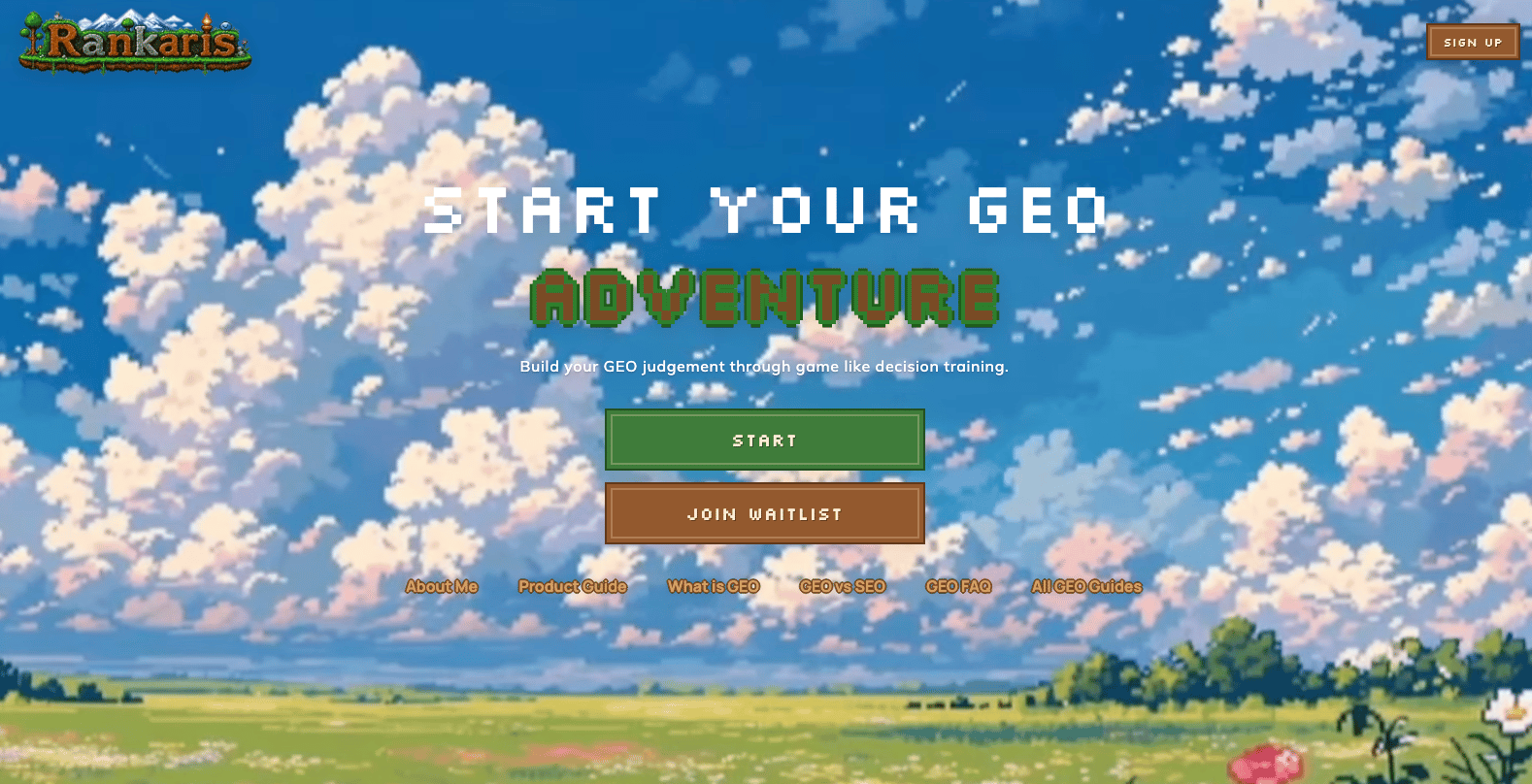
Rankaris is much narrower. It is a game-based GEO judgment trainer for early-stage founders, independent developers, and small website teams. The Product Guide describes a loop built around principles, choices, scenarios, and feedback windows.
The easiest way to understand the difference is to look at what each product asks you to produce.
| If you need to... | Better fit | Why |
|---|---|---|
| Learn GEO from the beginning | Coursera | The Edureka Specialization provides a defined sequence and broad topic coverage. |
| See a syllabus before committing | Coursera | Modules, assessments, projects, and intended outcomes are publicly described. |
| Earn visible completion evidence | Coursera | The official page advertises a shareable certificate. |
| Practice choosing between several valid actions | Rankaris | Its scenarios are designed around prioritization under constraints. |
| Improve the reasoning behind a live-site backlog | Rankaris | The practice unit is a decision and its rationale, not a completed lesson. |
| Start immediately with a mature public program | Coursera | Rankaris is currently in early access with a Join Waitlist route. |
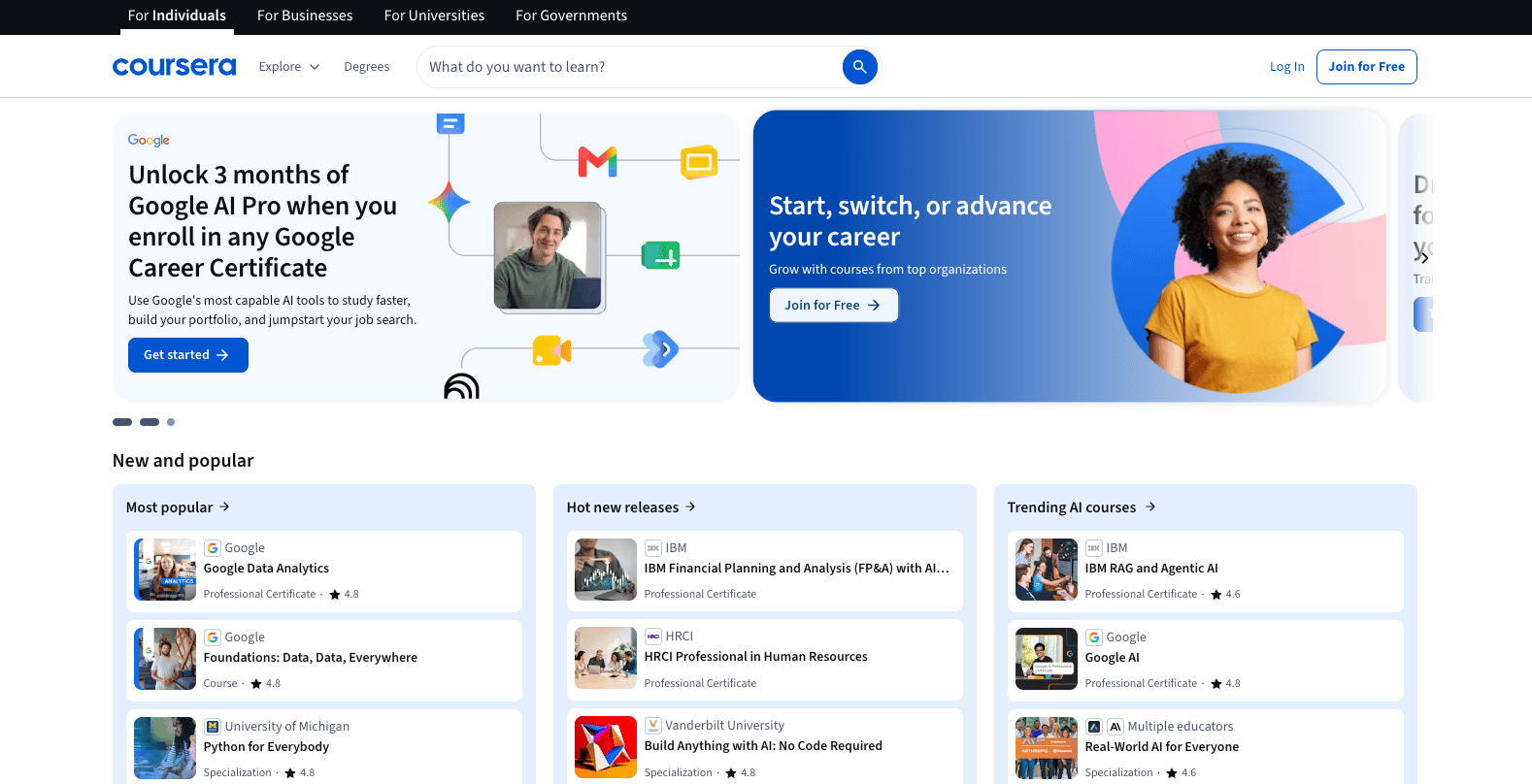
Calling Rankaris a full Coursera replacement would be sloppy. It does not replace Coursera's catalog, credentials, or conventional course experience. It becomes a real alternative only when another course is no longer the thing holding you back.
Where Coursera is the better choice
Beginners usually need someone else to choose the sequence. Without that structure, it is easy to collect disconnected advice about citations, schema, content quality, brand mentions, and AI crawlers without understanding how the pieces fit together.
The Edureka Introduction to Generative Engine Optimization page lists videos, readings, quizzes, credibility checks, comparisons between search results and AI answers, citation exercises, and a strategy-roadmap project. Its separate Generative Engine Content Optimization course describes guided lessons, examples, exercises, and assignments focused on content strategy and evaluation.
That structure has real value. A new learner can see what is covered, work through it in order, and use the assessments to find obvious gaps. Coursera also gives you access to adjacent subjects such as SEO, analytics, content strategy, and generative AI. Sometimes the supposed GEO problem is really a weak foundation in one of those areas.
The platform name should not do too much work in your buying decision, though. Course quality depends on the provider and the freshness of the material. Before enrolling, inspect the module-level syllabus, update cues, exercises, intended audience, and the exact outcome being promised. A polished course page tells you what the provider intends to teach. It cannot tell you whether a learner will transfer that knowledge to a real site.
Where Rankaris earns a place
I designed Rankaris after seeing a different problem. Founders and small site operators were not short of advice. They had audits, threads, dashboards, and long lists of plausible improvements. What they often lacked was a sound reason for doing item seven before items two, four, and nine.
Imagine a founder with four hours on Monday morning. The site has thin comparison pages, weak author evidence, inconsistent internal links, and a few technical warnings. Every item is legitimate. A course can explain each one, but explanation does not settle the order.
A useful Rankaris round would force the learner to make the call:
- Name the constraint most likely to block progress.
- Choose one action and defer the rest.
- Record the evidence behind that choice.
- Set an observation window that matches the change.
- Decide in advance what result would change the next move.
The important artifact is the rationale. If a learner chooses to strengthen a comparison page, for example, the work is incomplete until they can say which buyer question the page should answer, what source or first-party evidence is missing, and what they will inspect after publishing. That reasoning survives even when a dashboard, tactic, or AI platform changes.
This is also Rankaris's boundary. It is not a broad curriculum or a credential system. Its public material explains the intended practice loop, but a mature module inventory, integrations, and independent learner outcomes are not publicly verified. Early access may be acceptable for a founder who wants to help shape the product. It is a poor fit for someone who needs a fully inspectable program today.
Do not buy either product for an outcome it cannot promise
GEO education has an evidence problem. The foundational KDD 2024 paper, GEO: Generative Engine Optimization, introduced a benchmark and reported visibility improvements in its experimental setting. A July 2026 critical survey of 45 GEO studies warned that existing results do not establish stable, longitudinal effects across platforms or prove downstream business impact.
Google is also fairly direct on this point. Google Search Central says the usual SEO fundamentals still apply to AI Overviews and AI Mode, with no special AI-only optimization required.
So be wary of any course or simulator that quietly turns learning claims into visibility guarantees. A program can teach you to evaluate sources, improve pages, or make cleaner decisions. It cannot guarantee a citation, ranking, signup, or sale. The final test still happens on a real site: publish the change, preserve the evidence, watch the relevant search and business signals, and revise the decision when the result disagrees with your theory.
How I would choose
Choose Coursera if you cannot yet explain the core concepts without leaning on someone else's notes. The visible curriculum and familiar learning mechanics are useful, and the certificate may matter if completion evidence is part of your goal.
Choose Rankaris if you already know the vocabulary but keep getting stuck at prioritization. You should be comfortable with early access and more interested in the quality of your decisions than in a credential.
Use both when the handoff is explicit. Learn one concept in a Coursera module, apply it to a real page, write down two competing actions, and choose one. If you cannot explain the concept, go back to the course. If you understand it but cannot make the call, that is where judgment practice earns its place.
The worst option is endless course consumption disguised as progress. Once you can explain the idea, put it under pressure. A useful GEO education should eventually change what you do on Monday morning.

About SeanG
- Founder of Rankaris
- Former systems designer focused on AI search for over 2 years
- Independent developer writing about GEO and AI visibility
Identity: X · LinkedIn · gsc578045031@gmail.com